Saturday, 8 March 2014

Landmarks

LANDMARK  ROCKS

    We can be quite certain that rocks sitting on the plains on Tanzania today, were in the very same places in the 1870s.
This is exciting as it means these rocks were standing there when 
our Dr. Dillon passed by.
     The only transport for Dillon and the Expedition was with donkeys, as shown below.


And Dillon would have travelled along the main route westwards. This would have been a dust track.  These animals were not and are not shod with shoes of any type, so moving over the dust track is easier on their feet than going along the packed down roads, or the paved roads. 


We drove along the packed road shown here. 


More modern paved roads are raised up to allow water run-off during the rainy seasons.


 A cart being pulled along by two cows travels along the track beside the paved road which is built to allow rain run-off.

The road pavement would have torn away at the cows' hooves


Parts of the plains of Tanzania, between the Indian Ocean and Lake Tanganyika, are littered with landmarks on all sides along the way.

These landmarks are rocks, either now in piles or groups, or very large rocks standing out on their own.


Each rock pile looks different.  To those travelling past, they seem to cheer you on your way.

I was always interested in the rocks, on the look-out for the rocks sketched in Cameron's book "Across Africa."

Here are copies of the two main sketches:


These sketches show 2 campsites set up by members of the Expedition.

These giant rocks are what my geological adviser tells me are erratics.

They were carried to their present location by some massive force - either moved by a glacier, or by a glacial flood - where the back end of a glacier melts faster than the front end, forming a lake which bursts out through the front dam of ice at some point and sweeps all before it across the plains in a spectacular surge of power.


And then - 

I was CERTAIN I had found this rock sketched on the left.  I was CERTAIN I had touched where Dr. Dillon, his friend Lt. Cameron and their supporters had camped for a few days' respite.


Long-distance view


 There were no other erratics that we saw that even remotely resembled this shape.


Closer


Right there!


Perhaps it was THE ROCK, but when I got home and checked all the pics again, I wasn't so sure!
But - doesn't really matter if not perfectly correct!


And, how do modern-day Tanzanians travel around these plains?


They are excellent cyclists. 


And they use their bicycles for transport of personal goods


But the most frequent method of travel or transport is by walking


These women are carrying loads of wood for fuel.  

They were singing as they walked along, to encourage each other to keep going.


Here men are carrying wood along a road, with a modern truck driving up behind.

The old and the new.


Next time - modern vehicles in a vanishing world.
 Thank you for reading along.
News on book publication when I hear from publisher.

Saturday, 1 March 2014

Villages

VISITING  VILLAGES
Remembering this blog is about Dr. Dillon.
 Many of the villages shown below have changed only slightly since Dr. Dillon strode through them.


 The differences today would be the electric wires and supporting poles, and the corrugated roofs.

In Dr. Dillon's time there would have been no wires, no poles, and rush-thatched roofs.

One other difference is today's inhabitants are fully clothed.


 This view shows tire tracks in the dust, 
and corrugated roofs and 
some stone walls.  
Also note the poles and the wires.

It was this photo, along with some others, that brought the following comment from a friend, who used to travel widely throughout Africa.  She said, "I am so impressed at how the villages of Tanzania have progressed into this century.  They are indeed doing very well.
  I congratulate them."


Perhaps this charming view down a village street, with a mountain rising up behind, was the same in Dr. Dillon's time, but the walls would not have been so permanent, and the roofs would have been thatched.


 In the distance from where we were, and in amongst the trees, is what I would call a village compound.  In other words, a collection of homes, built close together for protection from the outside world.
In the '60s in North America, this would have been called a commune.  But these did not survive - here in Tanzania, the concept continues to flourish. 


Closer to the compound above,
with some residents in front.


A sunny afternoon - lots to see here - electrical transformer, bicycles, vehicles in the distance, socializing in the shade.

All the women are somewhere else, working, or taking care of the children, at home.


A more modern scene - pavements, electricity poles, metal roofs, white car, and solid buildings.


.


The produce was usually displayed "outside" but under covered stalls, always remembering the rainy seasons swamp everything.


 A modern Tanzanian scene.
Because it is "modern" 
there are advertisements and vehicles.
Notice the trees well established and planted where a vehicle could park in the shade.

How many times have we been in a vehicle in a "modern" North American parking lot, unable to find any shade from the midday sun?
The line down the centre of this photo is the half-open window of our land rover.  We did not want to intrude into people's lives!


Here is an established supply centre for the surrounding area.

The ads and the goods are definitely different to what Dr. Dillon would have seen, and there would not have been bicycles, but the concept of a general store managing to supply the demands of a region, would have been similar.


And next door is the local "photocopying centre."


One of the cousins on our tour was a member of the "younger set."

He found this of interest!


And this one, too.

Local Artwork and Thank God!  Coca Cola!


But the further we got from larger centres, the more there was on display for local sale.


Here is a very common, and very vivid example of
materials for sale.


Do you want to purchase a mattress?

This is the place to go.


A very well-developed village stall offering for sale: nuts and seeds for consumption, and all kinds of spices and dried herbs.


Do you need a cable network?


Perhaps a hair cut?


If you own a vehicle, maybe you
should have a tune-up?


 If you need meat, here is a stall offering
fresh cuts you could buy.

Always an issue in hot climates: how to keep meat fresh.

The animals would have been slaughtered
that day, and the meat was being assaulted by flies.

If you had purchased this meat, you would have had to cook it all the same day . .


And, of course, wherever man gathers,
and for whatever reason,
he leaves his mark,
polluting his environment.


And Africa So Beautiful
surrounds the traveller
on all sides.

This Jacaranda tree,
planted by
Who-Knows-Who
stood tall and strong,
a gorgeous sight,
in central Tanzania!
 For more on the Jacaranda Tree, click on this link:


We are approaching the end of this Trail

Next post:
How transport has changed in Tanzania.
 Thank you for reading along!
It is thrilling how this blog is read around the World!

Tuesday, 25 February 2014

Markets

MARKETS

Outside the main centres on the east coast of Tanzania, there are three ways to purchase food and goods:
                               1. along the roadside
                               2. in large open-air markets, set up only on certain days
                               3. village shops

In this post, we will cover the roadside and open-air markets.
Next post - shopping in a village

PLEASE NOTE:
Many times we did not take pictures, which would have required focusing and light quality adjustments.  It would have been obvious to everyone what we were doing.  Mostly people didn't want us to snap them as they went about their daily business.  Some felt by doing so we were stealing something from them, something spiritual or part of their essence.  We trod carefully, having no desire to intrude or to be remembered as thieves.


A small roadside selling point
with temporary shade - in Tanzanian colours
of green and yellow!

NOTE:  centre, back, in the shade, is the lady of the stall.  Her husband is in the shade behind the produce.  The crouching man with the white hat,  is examining the produce, before making a purchase.


Here is a more developed roadside market - the shade provided is permanent, left standing when the day's sales are over.

The produce is brought in baskets, woven so beautifully (see close-up below) using rushes and grass.

The strength of the basket weaving lies in multiple triangles in the weaving.


 Bags of fuel for sale along the roadside.

The fuel is of two types:
branches of trees, maybe transported here for many miles - carried in bags across the carriers' shoulders
and
elephant dung, each about one foot long, now dried,
or
 cattle dung patties, collected by herders.
All packaged in white bags


These ladies are standing in a "line-up"
waiting for their turn to make a purchase.

We did not know what was being sold out of the bags


These are permanent
sale shelter areas
shelter from rain in the "rainy seasons"
and shade from the midday sun in the dry periods.

Built in a bend of the road.


Our guides took us here, to visit an organized market.  It was too early for the sellers to open up, but they had come early to claim a site for their stalls.

It was chilly at that early hour, but, in no time, the heat would rise.

The market is on a slope - to allow good run-off in the rainy seasons.

Very soon after this photograph, the stalls had been set up and these were some of the goods we saw for sale:


Some of the produce was expertly piled up.


Every kind of pepper!


The produce on display is of high quality!

Note the weighing scales on the table.   


The largest, organized outdoor market
we visited.


These markets are not only places where people gather to buy and sell.
It is here that people meet and exchange gossip and tell the news from their villages.  These folk have been attending these markets all their lives and they all know each other and support each other.


Next post:

Villages we passed through
Centres of Commerce and of Socialising

Thank you all for reading along.  We have had over 1100 page-views so far!

Wednesday, 19 February 2014

Honey

BEES  and  HONEY

 To create the mood for a few moments of thinking of bees and their work, let's look at this poem by Emily Dickinson, an American poet who lived 1830 - 1886, spanning the whole life of our Dr. Dillon:
                             THE  BEE          
            Like trains of cars on tracks of plush
            I hear the level bee:
            A jar across the flower goes,
            Their velvet masonry

            Withstands until the sweet assault
            Their chivalry consumes,
            While he, victorious, tilts away
            To vanquish other blooms.

            His feet are shod with gauze,
            His helmet is of gold;
            His breast, a single onyx
            With chrysoprase, inlaid.

            His labour is a chant,
            His idleness a tune;
           Oh, for a bee's experience
           Of clovers and of noon!
Emily Dickinson
[NOTE:  onyx (black) and chrysoprase (green) are gemstones.]

In the past, sugar did not arrive for consumption in bagsHoney was such a prize!  It was natural that honey production would be of great interest.  Today, this production is supported and encouraged, but on a local scale, with a view for sale at local markets.

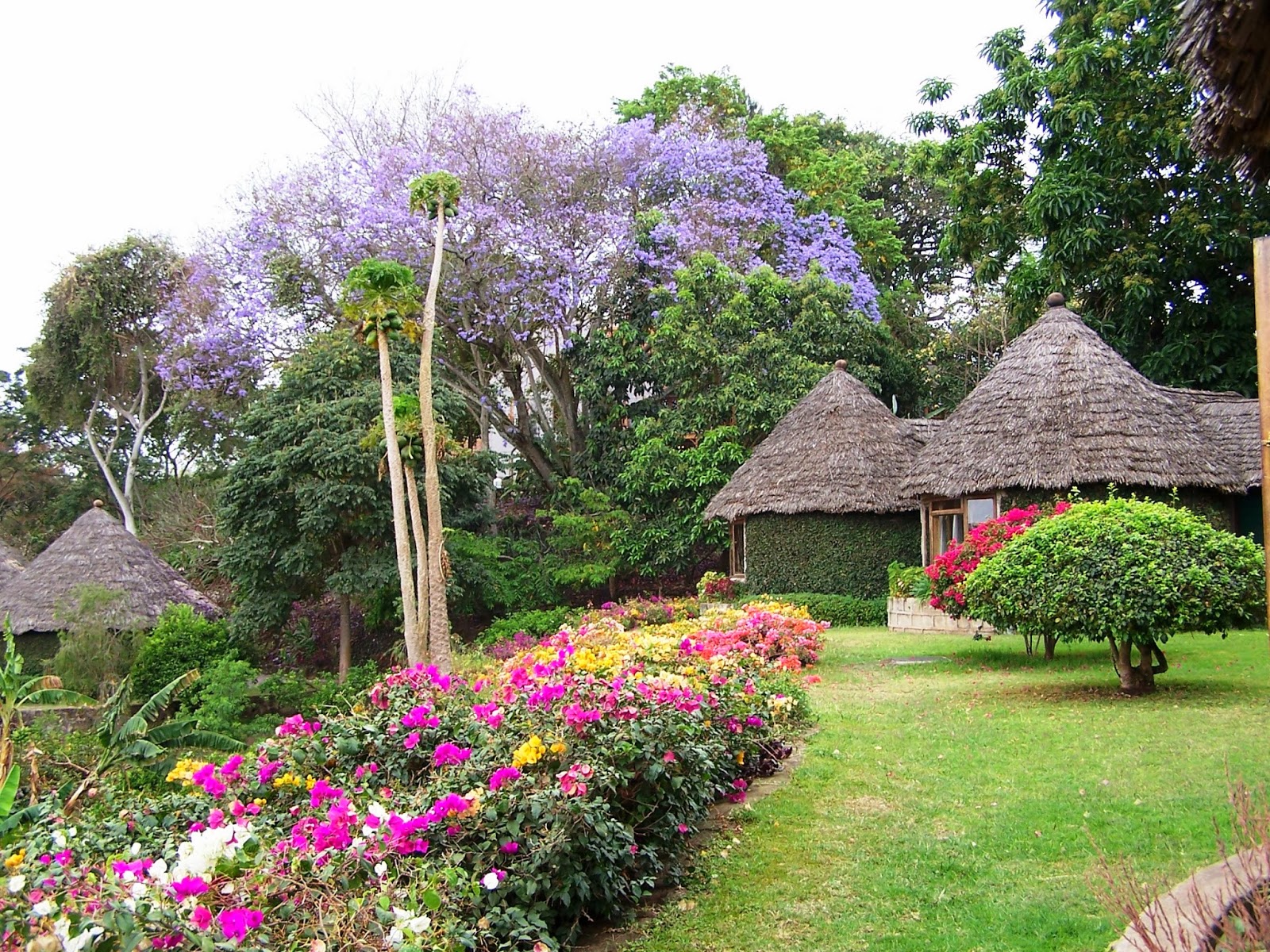
We all know it is bees who make honey from nectar they gather from flowers.  Africa has many flowers - to be found on trees, and on the ground.  In a few places they have been cultivated.


These are views of the grounds of some of the hotels
where we stayed.


How are the bees encouraged to have their nests in places accessible to the gatherers?
In trees, mostly some distance from the roads we travelled along:

Here are tubes, suspended by string or rope, swinging in the wind, holding bee nests:


This close-up shows 2 sausage-shaped bee hives


 How did the gatherers get up so high to collect the honey?


We saw this fellow climbing trees to gather coconuts near ZanzibarHe has only a strap of rope around his feet, and a circle of string between his hands, to give him traction.  The tree's bark was smooth.

We didn't see the honey gatherers at work, but we assumed they gathered it using similar techniques.


This fellow showed us his loop of string, which he used to climb up the trees to pick coconuts.


All of these trees hold bee nests in tubes!
Too high to be reached by any honey-loving wildlife.


And here's a tube up-close.


And now that the word MARKET has been mentioned

Next time:  Let's visit some markets we noticed as we drove around Tanzania.

Thanks for joining in reading this blog!